
How a Meal Becomes a World.
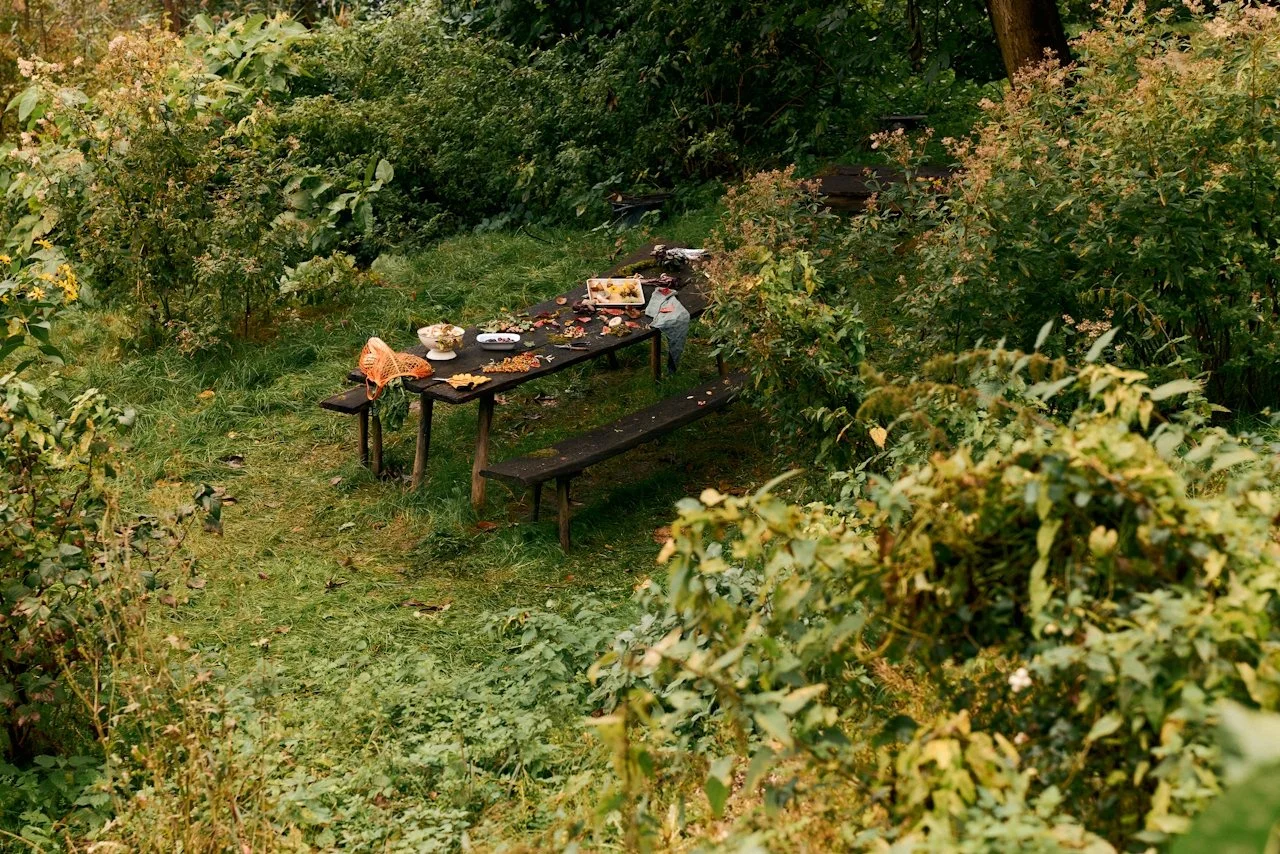
Every table begins as a feeling.
Not a menu. Not a floor plan. Not a guest count or a color palette or a mood board, though all of those things come eventually. It begins with something harder to name — a quality of light, a memory of a meal eaten somewhere once that lodged itself in the body and never quite left, a sense of what this particular gathering of people deserves to walk into.
This is where we start. Every time.
The question is never what should we serve. The question is always what world are we building, and what does it feel like to live inside it for a few hours?
What follows is as close as we can get to articulating a process that is, at its core, more intuitive than systematic. A look inside the way Feast with Fiore builds a table from the ground up — from the first conversation to the moment a guest walks in and the room does what a room does when it has been composed with intention.
The First Conversation Is Never About Food
When someone comes to us — a private client planning a dinner, a brand organizing a retreat, a family building a celebration table, a creative studio designing an experiential event — the first thing we ask about is almost never the menu.
We ask about the people. Who is coming? What do they do, what do they love, what does a perfect afternoon look like for them? We ask about the space — not its dimensions but its feeling. We ask what the host wants their guests to carry home, not in their hands but in their bodies, that particular residue of an evening that settles somewhere between memory and mood and stays for days.
We ask what would make this gathering irreplaceable rather than simply good.
These are not small questions. They require the client to think about hospitality as an act of intention rather than logistics — to consider that a table is a form of communication, that what you serve and how you serve it and what surrounds it on the surface tells your guests exactly who you think they are and how seriously you take their presence in your life or your space.
Most people, when asked these questions, go quiet for a moment. And then they say something true. And that true thing is where we begin.
The Geometry of a Table
Before a single ingredient is sourced or a single stem is cut, we think about the geometry of the table.
This is not about symmetry. In fact, some of the most compelling tables we have built have been deliberately asymmetrical — the kind of arrangement that feels gathered rather than placed, as though the abundance arrived naturally and settled where it wanted to. There is a difference between a table that has been decorated and a table that has been composed, and that difference lives almost entirely in the relationship between the objects on its surface.
We think about movement. Where does the eye travel first? Where does it rest? A croquembouche at the center of a dessert cart commands the room differently than the same cart arranged with its height off-center, the tower leaning slightly into a scatter of silver bowls filled with fruit. One is a display. The other is a scene.
We think about negative space — what is not on the table is as important as what is. A surface crowded to every edge communicates abundance but not ease. A surface with breathing room between its objects communicates that each thing was chosen, that nothing is there accidentally, that the host thought carefully about what deserved to be present.
We think about height and depth. The flat table is the least interesting table. When objects move vertically — a tall vessel here, a low ceramic bowl there, a cutting board that sits slightly raised on a linen fold — the surface becomes a landscape rather than a still life. It has topography. It rewards looking.
What Flowers Do That Food Cannot
There is a conversation that happens between flowers and food on a well-built table, and it is unlike any other design relationship we know.
Food has color, texture, and form, but it is transient — it will be eaten, rearranged, diminished over the course of an event. Flowers have longevity and a particular quality of wildness, even when they are carefully arranged, that food does not possess. Together they create something neither can achieve alone: a surface that feels simultaneously cultivated and alive, considered and effortless.
We use flowers the way a film director uses light — not to decorate but to direct. A low garden arrangement placed at one end of a long table draws guests toward it, creates a focal point, gives people a reason to move and linger. A single stem resting against a stack of ceramic plates is a detail that registers subliminally — the guest does not necessarily notice it consciously, but they feel the care it represents.
The flowers we choose are almost always garden varieties. Roses that look grown, not bought. Sweet peas and ranunculus and dusty miller and whatever the season in California is actually offering, because a table that looks seasonal feels true in a way that no amount of imported, out-of-season blooms can replicate. There is a honesty to a flower that grew nearby that guests feel even when they cannot articulate it.
We never want the flowers to compete with the food. We want them to be in conversation with it — to share the surface the way two people share a table, each present, each distinct, each making the other more interesting by proximity.
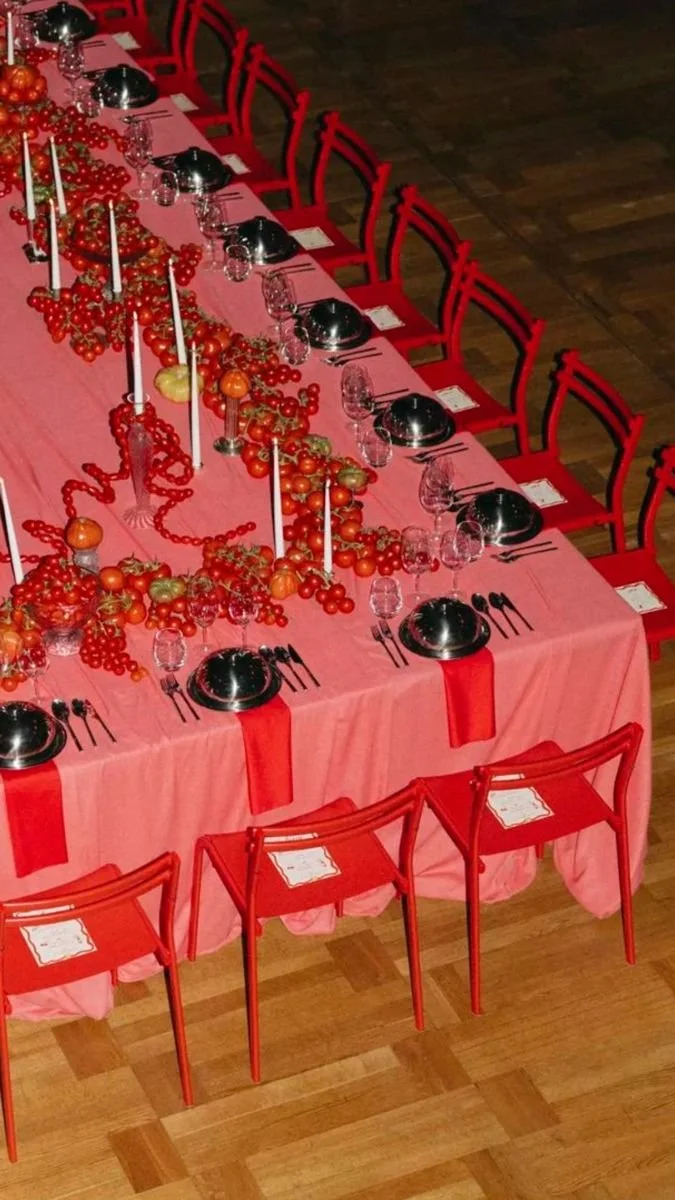
The Vessels Are the Vocabulary
If flowers are the language of feeling, vessels are the grammar.
The container is never neutral. A piece of food placed in a deep-glazed ceramic bowl says something categorically different from the same food on a slate slab or a pale marble surface. The ceramic says warmth, handmade, personal, the kind of kitchen where someone actually cooks. The slate says precision, restraint, a certain cool confidence. The marble says occasion, abundance, the classical tradition of the feast.
We collect vessels the way some people collect art — with genuine obsession and a clear point of view. Handmade ceramics from Los Angeles makers. Vintage silver pieces found in estate sales and flea markets. Glass that catches light differently at different hours. Wooden boards that have developed a patina from use, not from styling.
These objects carry history, and history is what gives a table depth. A bowl that looks like it has been used — like it belongs to someone, like it has held food before and will hold food again — creates an intimacy that a brand-new vessel from a rental company simply cannot manufacture.
This is why we invest so heavily in our own collection of vessels. They are not props. They are characters. They appear at different events, in different configurations, in different relationships to different foods and flowers, and they bring with them a continuity — a sense that the Feast with Fiore table exists as a living, evolving aesthetic rather than a service that deploys interchangeable equipment.
The Chef Station as Theater
There is a particular electricity that enters a room when a chef is working in it.
Not behind a door, not in a separate kitchen, but present — at a station that has been designed as part of the event's visual and experiential landscape. The open flame, the focused concentration, the specific choreography of a skilled cook working with intention — these things change a room. They remind the guests that what they are about to eat is being made, right now, by human hands, with real ingredients, in real time.
We design chef stations with the same attention we bring to the table itself. The station should feel like it belongs in the room — visually coherent with the overall environment, not a utilitarian intrusion. Fresh herbs in their bunches, ceramic prep bowls, a cutting board with the particular beauty of real use. The equipment should be present but not dominant. The cook should be visible but not performed.
What guests feel at a well-designed chef station is something close to the feeling of being cooked for at home by someone who is genuinely good at it — that rare combination of watching someone do something skillfully and knowing that the result of that skill is about to be yours. It is intimate in a way that plated service, however beautiful, is not.
For retreat dining and executive off-sites, the chef station often becomes the social center of the event — the place where guests gather, ask questions, watch, and begin to talk to each other. Food as icebreaker, not because it is casual, but because it is alive.
The Moment the Room Shifts
We have watched this happen many times, and it never stops being the thing we work for.
A guest walks into a room where the table has been set. They stop. Not consciously — it is not a performative pause. It is the involuntary arrest of a body encountering something that is more beautiful or more considered than it expected. A half-second in which the nervous system registers: this was made for me. Someone thought about me before I arrived.
That half-second is everything.
It is the moment when a gathering stops being an event and becomes an experience — when the guest shifts from attendee to participant, from someone who showed up to someone who has been received. It is the moment when food stops being food and becomes hospitality in the deepest sense of the word: the art of making another person feel that their presence in this specific place, at this specific time, was genuinely desired and genuinely prepared for.
We build every table toward that moment. Every vessel chosen, every stem placed, every dish composed is in service of that half-second when a guest walks in and the room does what a room can do when it has been built with love.
Everything else — the meal itself, the conversation, the hours that follow — grows from that moment.
The table is always where it begins.
Feast with Fiore creates cinematic food experiences throughout Los Angeles — private chef dinners, food installations, retreat dining, and celebration tables built from the ground up with intention.